Beluga whales have sensitive hearing, little age-related loss
-
 Loading...
 - Veronica Gutierrez
- 20 Jun 2021
- 933 Views
- 0 Like
- 0 Comment
Scientists published the first hearing tests on a wild population of healthy marine mammals. The tests on beluga whales in Bristol Bay, Alaska, revealed that the whales have sensitive hearing abilities and the number of animals that experienced extensive hearing losses was far less than what scientists had anticipated.
The latter findings contrasted with expectations from previous studies of humans and bottlenose dolphins, which showed more hearing loss as they aged, says Aran Mooney, a biologist at Woods Hole Oceanographic Institution (WHOI) and lead author of two new studies on beluga whales. "But unlike the wild beluga population, the dolphins that were studied lived in a very noisy environment, as most humans do."
At a time when noise in the ocean is increasing from human activities, such as oil and gas exploration and ship traffic, understanding the natural hearing abilities of whales and other endangered marine mammals is crucial to assessing potential noise impacts on animals and to management efforts to mitigate sound-induced hearing loss.
In the two related studies, WHOI researchers and their colleagues measured the hearing sensitivity of 26 wild belugas and then compared the audiograms to acoustic measurements made within their summer habitat in Bristol Bay to study how natural soundscapes-all sounds within their environment-may influence hearing sensitivity. The soundscape also reveals sound clues that the belugas may use to navigate. The first study was published May 8, 2018, in the Journal of Experimental Biology. Results from the soundscape study were published June 20, 2018, in the Journal of Ecoacoustics. "In the first paper, we characterized the beluga population's hearing ability, which had not been done before in a healthy, wild population," says Mooney. "And in the second paper, we put that into context to see how they might use acoustic differences in their habitat and how their hearing is influenced by the natural ambient noise in their environment."
How do you test a beluga whale's hearing? Researchers applied the same screening method that doctors use to test the hearing of newborn babies who can't yet vocally respond to whether or not they hear sounds: automated auditory brainstem response.
A suction cup sensor is gently placed on the whales' head, just behind the blowhole, and another is placed on the back for reference. A series of quiet tones are played, and the sensors help measure the brain's response to the sounds from the surface of the skin.
"It's fairly straightforward," Mooney says. "We just had to make a portable system that we could bring out into an extreme environment in order to perform the hearing tests."
The test itself goes quickly, taking only about five minutes to measure each frequency. The most challenging part, says Mooney, is catching the participants.
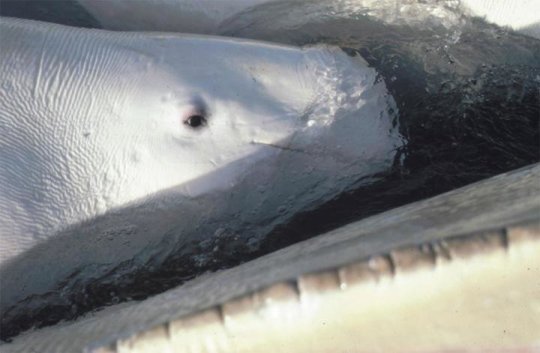
For that, the researchers relied on the expertise of Alaskan Natives who hunt belugas. From small aluminum boats, the team would approach an individual adult whale-no calves were included in the study-in shallow waters of the bay. Taking care not to stress or injure the whale, they would catch it in a soft net. Marine mammal handlers, including teams from Georgia Aquarium, Shedd Aquarium, and Mystic Aquarium, would then get in the water to help secure the animal's tail with a rope before moving it to a belly band (like a small stretcher) in the water next to a soft inflatable boat where the hearing tests took place.
"The belugas stayed relatively relaxed during the tests, seemingly employing a resting behavior that they may use to avoid killer whales," Mooney explains. "When a killer whale is hunting them, belugas will often move to very shallow water and quietly stay there until they can safely return to deeper waters."
In addition to the auditory testing, the researchers also performed a physical exam to assess the overall health, sex, and estimated age of each animal and obtained skin, breath, and blood samples to collect information on the whales' hormone levels, microbiome bacteria, and other health-related data. The assessments were part of a beluga population health assessment program coordinated by the NOAA Fisheries Alaska Fisheries Science Center, the Alaska Department of Fish and Game, and Alaska SeaLife Center. Satellite transmitters were attached to some of the whales before release to study the whales' movements.
The hearing tests revealed little hearing loss in the seemingly older members of the population, which could be because the estuary where the belugas reside is fairly quiet compared to more urban areas.
"Because there haven't been any other studies of the hearing of wild marine mammals, we compared the results to previous studies of captive dolphins in San Diego and in Russia," Mooney says. "The dolphins showed clear hearing loss as they aged, but the San Diego group lives in a very noisy environment, as most humans do."
Mooney and colleagues also compared the wild belugas tests to those of belugas living in human care facilities. Both groups heard similarly well, and the authors suggest that it is likely due to the quiet environments in which they live.
"Sensitive hearing within a quiet soundscape could allow belugas to detect predators, navigate, and communicate with their young via low-amplitude signals," Mooney explains. "This hearing sensitivity could be compromised in a noisier environment. It also suggests management concerns for animals that inhabit noisy areas, where they may already be showing greater proportions of hearing loss."
The two studies are important to efforts to evaluate the effects of underwater noise on endangered Cook Inlet beluga whales, whose numbers have dwindled to an estimated 328. The species lives in habitats close to Anchorage, AK, and is exposed to noise from shipping, pile driving, construction, and explosive noise from nearby military bases.