Debris From The Largest Comet Outburst Ever Recorded May Soon Be Visible
-
 Loading...
 - Santos Gonzales
- 26 Jul 2022
- 92 Views
- 0 Like
- 0 Comment
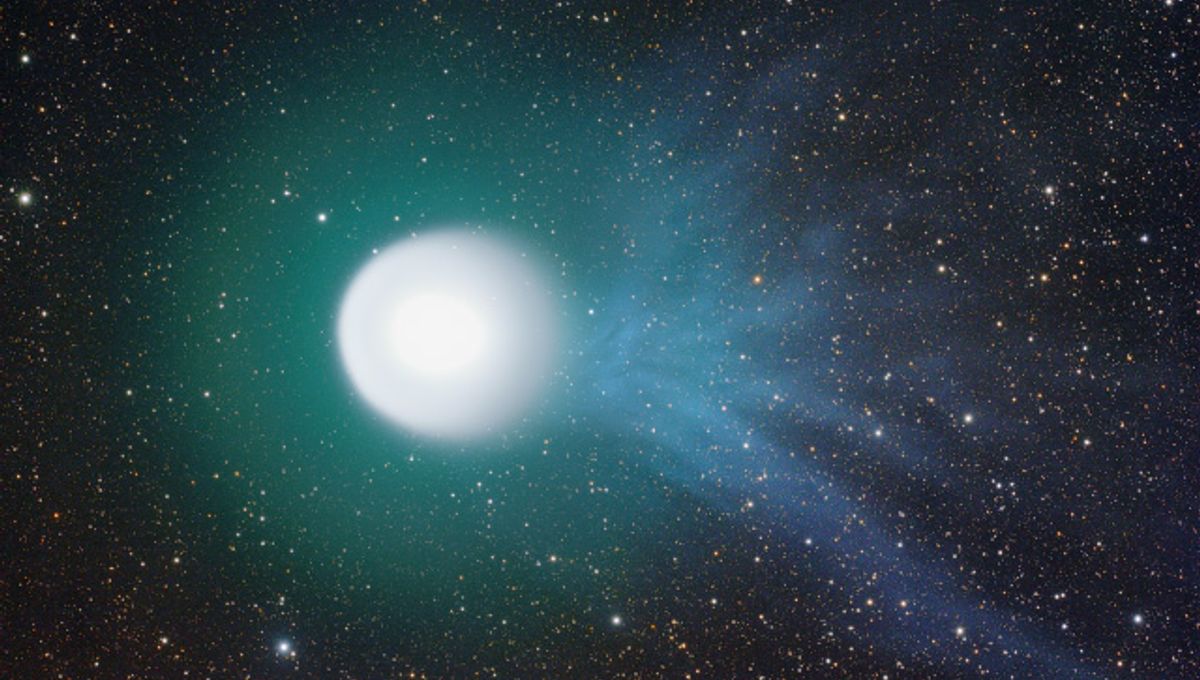
In 2007, after 115 years of behaving like a perfectly normal short-period comet Comet, 17P/Holmes brightened by a factor of a million in less than two days, the largest cometary outburst ever seen. In the process, it threw off such vast amounts of dust its coma was briefly larger than the Sun. Astronomers predict the material expelled in that outburst will be seen again in August and September this year, and again in February-March 2023.
Comets are unpredictable objects, as many patient watchers have learned. Many fail to live up to expectations in how bright they will become, or peak early. A precious few end up surprising on the upside. None, however, has matched the astonishing, and still unexplained, outbursts Holmes put on in 1892 and 2007, the first of which led to its discovery, which would otherwise have been very unlikely with the technology of the day.
Dr Maria Gritsevich of the University of Helsinki is most interested in what happened to the material Holmes threw off in these events. In Monthly Notices of the Royal Astronomical Society, she and co-authors modeled the path of the dust from the 2007 event.
Such small particles are subject to pressure from the solar wind, as well as the gravitational tug of the planets. Two particles of different size will follow diverging orbits even if they start from the same place, and we don't know the particle size distribution precisely. The dust motes can even change each other's orbits, so modeling movements is an immensely demanding task.
Nevertheless, the authors find the material thrown off in the outburst has formed an hourglass shape, with the lobes visible six months apart. “We predict that the evolved dust trail of the comet 17P/Holmes should be visible with even modest telescopes in 2022,” the paper reads.
While doing their calculations, the authors put out a call for amateur astronomers to be on the lookout for the debris in order to check their work, and the dust was detected just before the paper's publication in March. “The predictions of the paper were consistent with the new observations made in Finland in Feb-March 2022,” Gritsevich told IFLScience, giving the team confidence the dust will be visible at the times they predicted.
Why Holmes makes such immense outbursts is unknown, along with why it only happens on certain approaches to the Sun. Every comet consists, in part, of dust held together by ice. Solar warmth melting outer layers of ice releases both a mix of formerly frozen gasses and the previously trapped dust. Read More...