Extinction: Why scientists are freezing threatened species in 'biobanks'
-
 Loading...
 - paula summer
- 24 May 2022
- 283 Views
- 0 Like
- 0 Comment
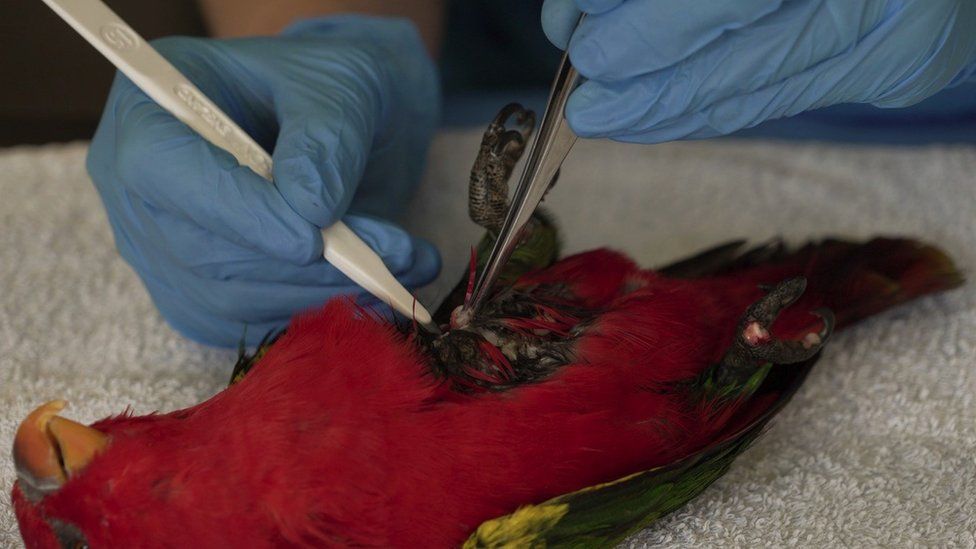
The bird is a chattering lory - an elderly resident at Chester Zoo, and a species listed by the International Union for the Conservation of Nature (IUCN) as vulnerable to extinction.
It is sad to see this striking, characterful bird having to be put to sleep. His small, clawed feet are gnarled with arthritis now too severe to treat.
It is not the end though for the unique genetic code contained in his cells. A few small pieces of his body will join samples taken from 100 species. They will be frozen - stored indefinitely - in the UK's largest biobank of living tissue, Nature's Safe.
In vials of a nutrient-rich, cell-friendly antifreeze, the samples are kept at -196C, at which point all the natural chemical processes in cells stop - they are suspended in animation.
The idea is that, at some point in the future - in decades, perhaps even centuries, they could be resurrected. This is a frozen backstop in case of extinction.
Life begins again
Conservationists say we're now losing species faster than ever. Amid a biodiversity crisis that, the UN estimates, threatens one million species of plants and animals with extinction, some scientists are now working out what to put in the freezer for the future.
"It's not going to stop extinction, but it'll certainly help," says Tullis Matson, founder of Nature's Safe.
Tullis is a tall, friendly and outspoken enthusiast for his charity's mission - preserving living tissue from wild animals.
"This is where life begins again," he beams, showing me an image of a vial of cheetah skin cells under the microscope.
The monitor is teeming with densely packed skin cells - a body's building blocks. The black dot in the middle of each spiky, connected cell is a nucleus containing a unique set of genetic instructions that made, in this case, a now deceased cheetah.
"This animal died in 2019," Tullis explains. "We woke up those cells a few days ago - and you can see now, they're all over the screen. They've multiplied and multiplied."
Skin cells are very good for this endeavour, particularly a type of connective tissue cell called a fibroblast. These are critical to healing and repair and - after being removed from the freezer and warmed to body temperature in a bath of necessary nutrients - will divide and multiply beautifully in a dish. Read More…