Extreme Sports Photography Tips

Extreme sports are action or adventure sports. They are not for the faint-hearted and have a certain amount of danger involved. These sports involve great heights, speed, or stunts. As a photographer, it helps to have a genuine interest in extreme sports in order to photograph them well.
1 Vary your Angles

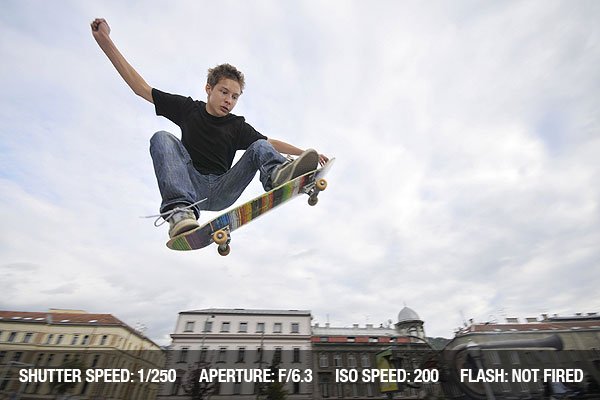
To get the most dynamic images from an extreme sports photo shoot, you ought to be extra creative with your angles – amplify them, make them extreme (pun intended) – which will in turn give you spectacular compositions! Don’t try to get too complicated, though. If you can get close to the action, use a wide-angle lens (28mm or 35mm) for exaggerated proportions and movement. A wide-angle lens will provide expansive compositions, but you’ll need to be fairly close with these small focal length lenses. Your own “vision” of how and where to acquire the action is going to be most important. Don’t be afraid to lie in the dirt to get your shot. These are called extreme sports for a reason; everything about them is supposed to be over the top.
2 Find the Right Spot

Many people will tell you that the perfect photograph is all about being in the right place at the right time, and that’s certainly true when shooting extreme sports. Watch how the participants handle the course before you select your spot. Turn the mode dial to TV or S (Shutter Priority) mode so you can control how you freeze the action, then pre-meter (and lock) your exposure. To get the most out of the event, use a 35mm – 50mm lens for the most advantageous field of view – not too wide (which would lead to distortion) and just beneath telephoto, so you can use a wider range of apertures.
3 Get Close to the Action

Instead of using a telephoto zoom lens – which tends to compress the overall image – move your lens and yourself closer to the subject. By moving closer, it is much easier to fill the viewfinder’s frame with your subject… in fact, consider using the frame’s edges for more creative compositions, i.e. don’t be afraid to truncate (cut-off) portions of the subject for a more riveting composition. Your main objective in extreme sports compositions is to pack as much energy into the frame as possible, and you do this by making it appear as if the subject can’t be held in by the frame’s boundaries.
4 Choose Burst Mode

Burst Mode is an auto-firing mode that enables you to rapidly capture action without having to wait for the shutter to recycle. It’s an effective way of shooting high intensity subjects. Set the lens to AF (Autofocus) and select continuous focusing (AI Servo AF Canon/AF-C Nikon) mode so that the lens can constantly maintain its focus on the moving subject. When photographing white backgrounds, like the snow in the photo on the left, you’ll need to overexpose the snow by at least 1 stop. This way the snow will appear white in the photo. The reason behind this is that your camera’s built-in meter determines the ideal exposure to an 18% gray. Accordingly, when the white background is metered, it will be underexposed if you follow exactly what the meter says. By pushing up the exposure 1 stop, you’ll move into the tonal range where the white is sparkling white. Read More...