How France became the unlikely home of the insect-farming industry
-
 Loading...
 - Ryan Griffin
- 20 Feb 2023
- 71 Views
- 0 Like
- 0 Comment
The country is known for its love of meat. Could the growing insect industry help to reduce agricultural carbon emissions?
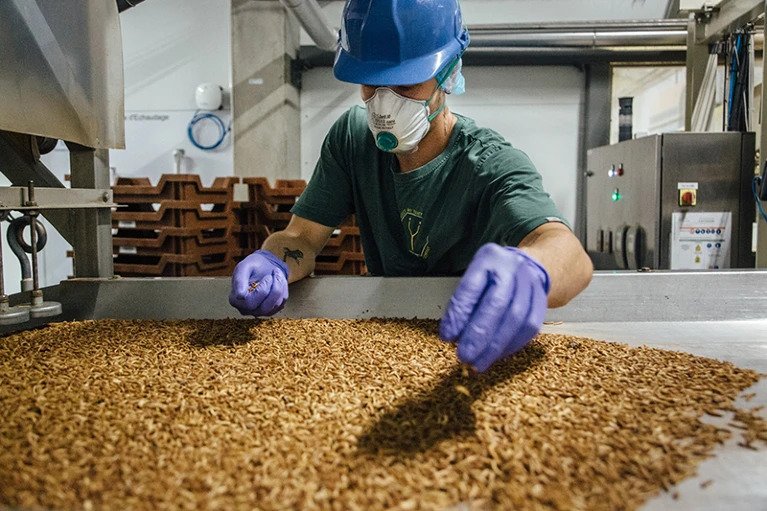
Walking into Ÿnsect’s flagship manufacturing site in Dole, eastern France, the first thing that visitors are met with is a hot, earthy, composting smell. With it comes the realization that this is not a typical factory. At 17 metres high, this is the world’s largest vertical insect farm — home to at least 3 trillion mealworm beetles (Tenebrio molitor).
The company’s chief executive and co-founder, Antoine Hubert, says that the beetles have a good life, as far as being an insect goes. Each of their stacked plastic trays is kept at an optimal 60% humidity and a balmy 25–27 °C. Nutrition, growth and moisture levels are all recorded for analysis, and human visitors are allowed to inspect the trays only from a distance — to prevent contamination of this prized ecosystem.
The beetles are raised in this way from larvae to adult, at which point they meet a quick death in steam before being harvested into oil, protein and fertilizer.
Insects have come under the spotlight over the past few years, as scientists seek alternative sources of protein to feed the rapidly expanding global population. A direct nutritional comparison shows that edible insect species have greater protein potential than do conventional meat products — 100 grams of mealworm larvae produces 25 g of protein, whereas 100 g of beef contains 20 g of protein1. Insects also have a high food-conversion ratio when compared with livestock. To produce the same amount of protein, for example, crickets require around six times less feed than do cattle, four times less than sheep, and half that of pigs and chickens2. But various attempts by companies to market insects as a mainstream food source in Europe and North America have fallen flat and largely been dismissed as a fad. And some researchers have concerns about the effects on the environment, ranging from whether escaped insects might disrupt local ecosystems to the impact of insect ‘factories’.
So why farm insects at all? “The world is facing a huge food sustainability crisis,” explains Hubert, an environmental engineer. “Insect protein is one very realistic and obvious solution to mitigating some of those challenges,” he says. Read More…