How Serbian street art is using the past to shape the future
-
 Loading...
 - Paula Dawson
- 15 Dec 2021
- 475 Views
- 0 Like
- 0 Comment
Belgrade’s Njegoševa Street is one of the most affluent areas of the Serbian capital. Lined with upscale boutiques and premium ice cream shops, it wouldn’t look out of place in Milan or Rome. But despite being one of the Balkans’ most desirable stretches of real estate, Njegoševa is blanketed in graffiti. Most can be traced back to Grobari VraÄar, a local gang of football ultras. Tags spelling out the letters “GV” in Cyrillic can be found scrawled across each façade, while a mural dedicated to legendary FK Partizan striker, Stjepan Bobek, stands proudly at the intersection with Smiljanićeva Street.
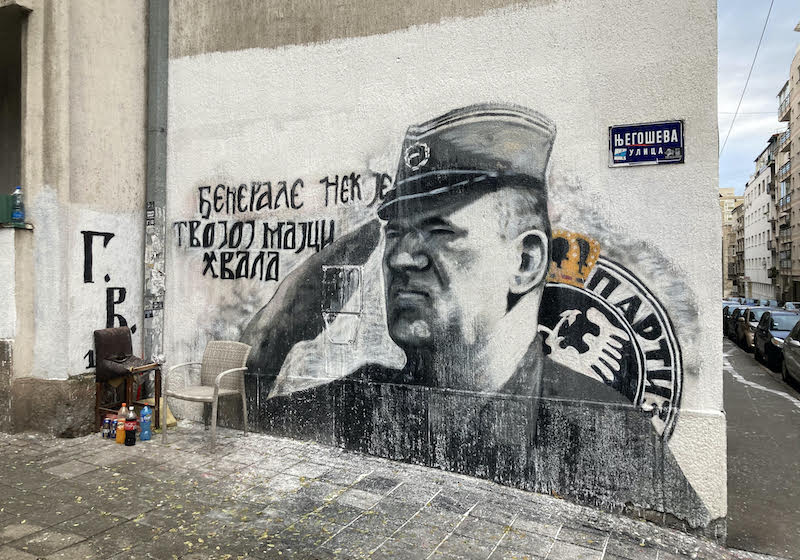
But one piece of graffiti in particular has captured Serbia’s attention. In July 2021, a mural depicting General Ratko Mladić, a convicted war criminal and the military leader of the Bosnian Serbs during the Yugoslav Wars, appeared on a wall on the corner of Njegoševa and Aleksa Nenadović Street. It came accompanied with the words: “general, many thanks to your mother”.
To some, the mural might look like an attempt to rewrite the past, by glorifying a convicted war criminal as a hero. In truth, in this case the past matters less than the future. Across the Balkans, political actors are using art alongside other means to reframe history. In the process, they hope to construct narratives that can be used to shape the future.
For Serbian progressives, Mladić is a source of shame and a stain on the national conscience. The mural has been vandalised multiple times in recent months. Yet for nationalists, Mladić is a hero who defended Serbian civilians from slaughter during the Bosnian War. Any damage is quickly scrubbed away by menacing young men in hoodies and Air Max trainers, who now take shifts guarding the artwork for almost 24 hours a day.
In an attempt to end this game of political ping-pong, activist group Youth Initiative for Human Rights (YIHR) allegedly made several fruitless requests to state bodies to have the mural removed. In November, they finally lost patience and announced that its activists would take down the mural themselves. This, predictably, enraged local nationalists, who declared that they would protect it by any means necessary. On the night of 9 November, there was a standoff between the two sides in front of the mural. Riot police surrounded YIHR activists, both preventing them from vandalising the mural, and saving them from having their heads kicked in by rightwingers.
But this isn’t the only mural devoted to Mladić in Belgrade. There’s at least a handful in the capital, and many more across Serbia and the ethnic Serbian enclave of Republika Srpska in Bosnia. Songs and banners celebrating Mladić can be spotted at football matches.
Many in Belgrade find his veneration painful and insupportable. “Symbols that depict convicted war criminals favourably are intolerable in any civilised society. Ratko Mladić disgraced both Serbia and its army by committing crimes against a civilian population,” says 28 year-old Marko Mihailović. He attended protests in solidarity with two women who were forcefully arrested after throwing eggs at the Mladic mural.
He attended the protest because “it was important to me to witness firsthand yet another symptom of the collapse of rule of law in Serbia,” he says. “[That] could be seen in the hundreds of cops that were mobilised to protect a single graffiti – which is in itself an offence [vandalism]. There would’ve been no need for a protest had the municipality, city or state performed its legal duty, which is to remove the graffiti and other hate symbols.”
But images of Mladic do still draw support from a wide segment of Serbian society, including many young people. “We’re overdoing it when we have, I don’t know, ten Ratko Mladić murals and want to paint a million more,” says Aleksandar Aleksić, a 22-year-old political science student from Belgrade who describes himself as a hard-right nationalist. He asserts that even though Serbian forces did commit atrocities during the Yugoslav Wars, these were the crimes of rogue soldiers and paramilitaries over which Mladić had no control. The International Criminal Tribunal for the former Yugoslavia disagreed. They sentenced Mladić to life imprisonment on charges of genocide, and crimes against humanity in 2017.
“I get that it’s excessive and extreme, but on the other hand it’s necessary to show and educate future generations [who Mladić was], so that one day my son or daughter asks: ‘dad, dad, who’s that? Why is he there?’. That man achieved something for this country, so I think that he deserves some kind of tribute,” says Aleksić. “So, this [mural] is in some way a tribute to Ratko Mladić and an expression of gratitude. It’s the most that those who celebrate him can do at a time when he’s imprisoned.” Read More…