Nigeria’s Ọ̀ṣun Òṣogbo Festival Celebrates the Power of a Yoruba Goddess
-
 Loading...
 - Patricia Solomon
- 15 Jan 2025
- 41 Views
- 0 Like
- 0 Comment
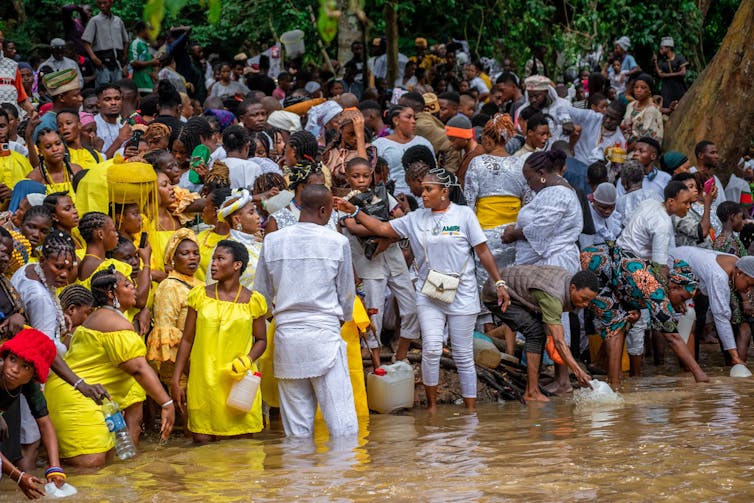
The Ọ̀ṣun Òṣogbo festival stands as the most significant annual event in Òṣogbo, located in south-west Nigeria. This vibrant celebration draws thousands of devotees and tourists from across Nigeria and around the world, serving as a devotional event and civic ritual dedicated to Ọ̀ṣun, a principal female deity in the Yorùbá pantheon.
The Significance of Ọ̀ṣun
Ọ̀ṣun is revered as the goddess of femininity in Yorùbá cosmology, ruling over the river named after her—River Ọ̀ṣun. Her spirit is believed to inhabit all freshwater bodies, and she embodies the qualities of motherhood, purity, fertility, and sensuality. As the patron deity of Òṣogbo, her origins are intertwined with the town, which dates back to the late 16th century.
As a historian and archaeologist, I have been drawn to the Ọ̀ṣun festival and the sacred site of the Ọ̀ṣun-Òṣogbo Grove to explore the history of Òṣogbo and the broader Yorùbá region over the past 500 years. The rituals, performances, and landscapes associated with the festival serve as vital repositories of memory, offering insights into the festival’s origins and its significance to the Yorùbá people.
Myths of Origin
The Yorùbá people, one of Africa's largest cultural groups, trace their ancestral language back to the Niger-Benue confluence area around 2500 BC. By 1000 CE, they had established a model of governance based on divine kingship and city-states, with a pantheon of deities reflecting their sociopolitical structure. Among these deities is Ọ̀ṣun, whose stories are integral to Yorùbá mythology.
One popular myth recounts how Ọ̀ṣun was one of the 17 deities sent by Olódùmarè, the supreme being in Yorùbá cosmology, to create the world. As the only woman among them, she was initially overlooked by the 16 male deities, leading to their failure to fulfill Olódùmarè’s mandate. Eventually, they recognized her importance and sought her guidance, resulting in the successful creation of the world, marked by fertility, peace, and abundance.
Another myth links the origin of Òṣogbo to a prolonged drought in the 16th century, which severely affected the community of Ìpolé Ọ̀mu. Two hunters, Láròóyè and Tìmẹ́hìn, were tasked with finding water and eventually settled near the river, unaware that they were encroaching on the territory of ghommids—mythical female creatures in Yorùbá folklore. After a confrontation with Ọ̀ṣun, the goddess forgave the settlers and made a pact with them, promising protection in exchange for respect towards her river and land.
The Festival’s Origin and Observance
To honor this pact, the founding community built a temple at the site of Ọ̀ṣun’s appearance. Since then, their descendants have returned annually to renew their covenant and pay homage to the goddess, whose waters and resources sustained them during times of drought. The festival, which typically occurs from late July to early August, serves as a time for community renewal and celebration of the Yorùbá faith.
The grand finale of the festival features a procession led by the Arugbá, a young virgin from the royal house, who carries a calabash filled with community sacrifices. This colorful and festive journey includes songs, drumming, and dance, culminating in solemn moments for the priests and priestesses. The festival not only reinforces the community’s bond with Ọ̀ṣun but also serves as a major driver of the local economy.
Cultural Significance
The Ọ̀ṣun festival acknowledges and reaffirms female power as a source of life and community building, central to Yorùbá cosmology. It also celebrates the pan-Yorùbá cultural identity, particularly significant since it was in Òṣogbo that the Yorùbá successfully resisted the Ilorin army’s attempts to impose Islam in the 1840s, a victory attributed to Ọ̀ṣun.
The Future of the Festival
The Yorùbá Òrìṣà religion is experiencing a resurgence both locally and globally, particularly in the Americas, with Ọ̀ṣun being one of the most popular deities in this expansion. The designation of the Ọ̀ṣun-Òṣogbo Grove as a world heritage site in 2005 is a point of pride for Nigeria.
Efforts to safeguard Ọ̀ṣun’s heritage and promote messages of gender equity, sustainability, and wellness suggest that the goddess will remain relevant in contemporary society. With a rich history and a vibrant present, Ọ̀ṣun continues to embody the essence of femininity and community strength, ensuring her place in the future of the Yorùbá culture and spirituality. The festival not only serves as a celebration of the goddess but also as a reminder of the enduring connection between the people and their ancestral beliefs, fostering a sense of identity and continuity in a rapidly changing world. As the festival evolves, it will likely continue to attract attention and participation from both local and international communities, further solidifying its status as a vital cultural event.