Pregnancy becomes a more vulnerable time with climate change
-
 Loading...
 - Oliver Smith
- 11 Apr 2022
- 335 Views
- 0 Like
- 0 Comment
In the western United States, where massive wildfires have fouled the air with smoke and hazardous levels of pollutants, Santosh Pandipati, an obstetrician in California, counsels pregnant patients to always check air quality before they venture outside to exercise. “You need to plan your outdoor activities when the air quality is better,” he tells them.
In other parts of the country, where hurricanes and floods have displaced pregnant residents, obstetrician Nathaniel DeNicola has advised patients, including those he saw in New Orleans, to pack a preparedness kit.
In case of evacuation, “they might be away from home for a long time,” he said. DeNicola encourages people to include emergency drinking water, extra supplies of medications and a paper copy of their medical records. “If the power’s out, that’s not typically available” now that most records are electronic, he said.
As scientists study how climate change is affecting human health, pregnant people and their unborn babies are emerging as a vulnerable group.
Those who must evacuate during natural disasters are often extremely distressed and might find their pregnancy health care interrupted. “If you have to flee, how do you make sure you continue to have access to your OB/GYN or to the hospital you plan to deliver in?” said Pandipati, who has seen patients who have escaped wildfires. “If you end up needing to go live with family an hour or two hours away, you have a disruption in care.”
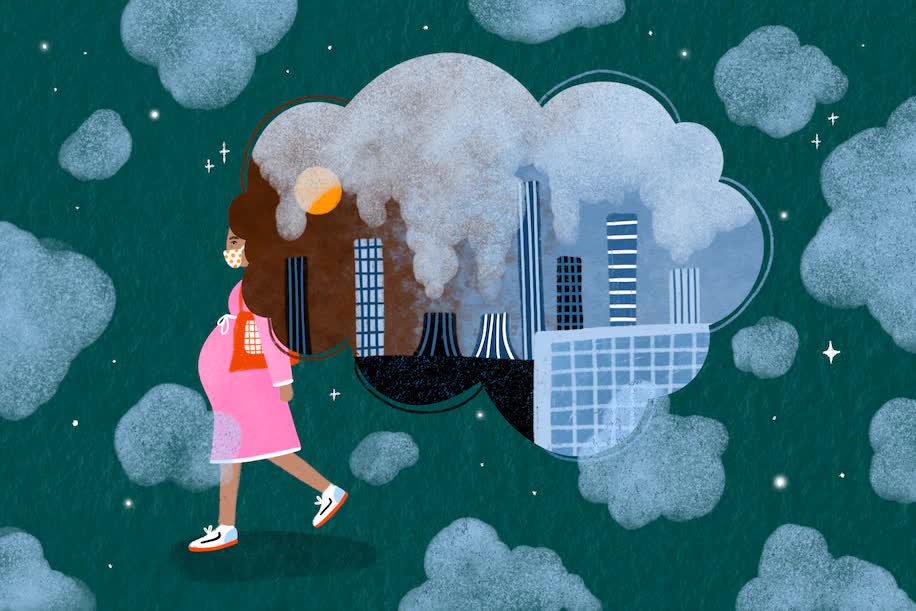
It doesn’t take a catastrophe to create problems. Ongoing exposure to hot temperatures and air pollution might raise the risk of adverse pregnancy outcomes, such as preterm birth and low birth weight.
About 7,000 California preterm births linked to wildfire smoke risks, study says
Spurred by growing evidence on climate-related effects, Pandipati and DeNicola have tailored their medical advice, not to alarm people, but to prepare them. “The reality is that we need to start telling our patients right now that the climate is changing,” Pandipati said. “We need to empower patients.”
In 2016, the American College of Obstetricians and Gynecologists issued a position statement on climate change, calling it “an urgent women’s health concern and a major public health challenge.”
Air pollution and heat exposure
Amid widespread changes wrought in the environment, air pollution and heat exposure have been significantly associated with preterm birth, low birth weight and stillbirth in the United States, according to a 2020 review published in JAMA Network Open. Such exposures are becoming increasingly common, according to the paper.
DeNicola, an obstetrician at the Johns Hopkins Health System in Washington, was one of the review’s co-authors.
Historic heat wave brings 100-degree heat to 40 million people in western U.S.
Exposure to high temperatures can cause dehydration. During pregnancy, dehydration can lead to the release of oxytocin, a hormone that contributes to labor contractions, he said. “The extreme heat could very well be causing an increase in that mechanism,” DeNicola said. “It’s revved up.”
If labor occurs and a baby is born before 37 weeks, it’s a preterm birth, compared with a normal pregnancy of 40 weeks. Some of these newborns may have immature organ systems and experience trouble with breathing, feeding and regulating body temperature. Long term, premature babies might develop other problems, including learning disabilities and hearing or vision problems. The more premature the baby, the more serious the health risks.
Racial disparities in exposure
In the JAMA study, women of all races were at increased risk for poor pregnancy outcomes when exposed to heat and air pollution, but disparities emerged. Black women consistently had the highest risks of preterm birth and low birth weight, said Rupa Basu, an epidemiologist who also co-wrote the JAMA study. She is chief of the air and climate epidemiology section at the California Office of Environmental Health Hazard Assessment.
Because of historical redlining, higher-risk communities might be exposed to more pollution from sources such as freeways, she said. Residents may also dwell within “heat islands,” urban locations that have higher temperatures than outlying areas. “There’s less green space and more buildings and cement and blacktops to really absorb and retain the heat,” Basu said.
Redlining means 45 million Americans are breathing dirtier air, 50 years after it ended
Anecdotally, Pandipati said he has seen the effects of heat waves on his patients, some of whom work in agriculture. He consults on high-risk pregnancies as a maternal and fetal medicine specialist with Obstetrix of San Jose. Some women travel to the Bay Area clinic from as far away as California’s Central Valley.
During one record-breaking heat wave before the pandemic, Pandipati noticed many ultrasounds with low levels of amniotic fluid in the womb — a situation that might require doctors to deliver a baby early. “These were moms who were saying that they don’t always have access to air conditioning, they’re often working more manually, either in agriculture or manual labor-type jobs, not always able to stay hydrated adequately,” he said. “I was starting to wonder, wow, I think this is really from the heat waves that we’re experiencing.”
“We just kept monitoring these pregnancies and then things just turned around and the fluid improved. They turned around as the heat wave dissipated,” he said. “We didn’t have to end up delivering them early.”
Air pollution and poor pregnancies
Air pollution, whether from urban pollutants or wildfires, has also been linked to poor pregnancy outcomes.
Air pollution affects preterm birthrates globally, study finds
Wildfire pollution may have contributed to as many as 7,000 additional preterm births in California between 2007 and 2012, according to a study that Stanford researchers published in 2021. Wildfire smoke contains fine particulate matter called PM 2.5, which can enter the lungs and bloodstream to create serious health problems. The researchers hypothesized that wildfire pollution might have triggered an inflammatory response that led to preterm delivery.
Weather disasters and mental health
There’s debate about whether human-caused climate change is producing stronger or more frequent hurricanes. But Hurricane Sandy, which struck New York and New Jersey particularly hard in 2012, offered a glimpse into how such devastating superstorms can place severe stress on pregnant people.
In a 2019 study that looked at pregnancy complications in New York after Sandy, researchers found a heightened risk of problems such as early delivery and mental illness. The latter peaked about eight months after the hurricane. In the aftermath of community disasters, post-traumatic stress disorder, depression and anxiety can develop.
Natural disasters trigger a cascade of health consequences, DeNicola said. While there may not be direct cause and effect on birth outcomes, “a lot of it is considered to be because of the stress of the event, either the stress of evacuation or the stress of difficulty getting potable water, the stress of maybe not having the typical indoor living conditions that you’re expecting,” DeNicola said. “You’re not having heat or not having air conditioning.”
“There are a number of physical stressors and psychosocial stressors that come with bracing for a natural disaster like a hurricane and an evacuation,” he said. “People posit, and I think it’s a reasonable concern, that that all prompts some kind of cascade in pregnancy that creates things like preterm contractions.”
A safer pregnancy
Both obstetricians routinely talk to their patients about air and water.
“You need more hydration in pregnancy in general. A woman’s blood volume will increase roughly 50 percent during pregnancy,” DeNicola said. “That’s a lot of extra volume to maintain, so hydration’s really important anyway. I make the extra point that as the seasons get hotter, which happens more often now, you’ll need even more hydration and you need to be aware of things like preterm contractions that are prompted by extreme heat and dehydration.”
Pandipati said he warns patients to watch out for heat waves and to keep an eye on the air quality index, too.
“Ideally, 1 to 50 is good air quality. If you’re starting to get up into the 50 to 100 range, you need to start modifying your activities, doing less outdoor exercise, not as long, not as hard,” he said. “If you’re already not feeling well, you’re coughing, you already have respiratory illness, you shouldn’t be out there.” Read More...