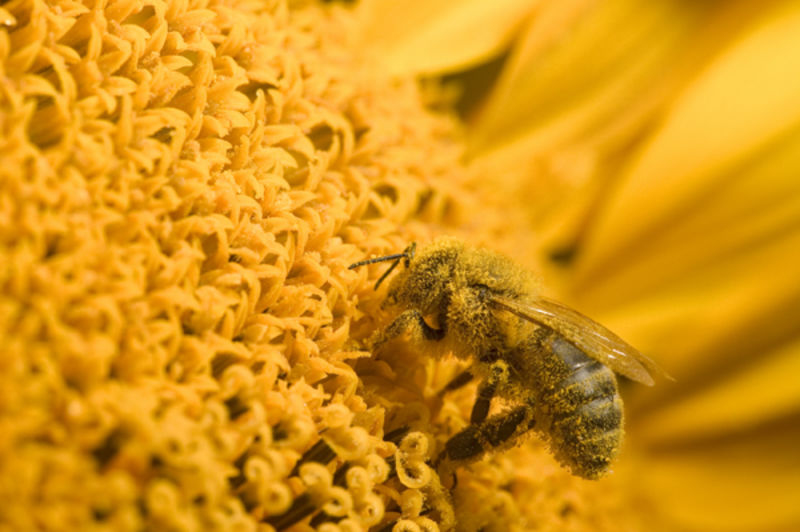
Scientists hail European ban on bee-harming pesticides
-
 Loading...
 - Monike Theodote
- 30 Apr 2021
- 1322 Views
- 1 Like
- 0 Comment
In a long-awaited decision, the European Union today voted to ban the use of three controversial neonicotinoid insecticides on all crops grown outdoors.
The vote ends years of bitter wrangling between those in favour of a ban, including environmental groups and many scientists, and opponents of further restrictions, including neonicotinoid manufacturers. It follows an influential scientific review which concluded in February that the insecticides posed a high risk to wild bees and honeybees.
As a result, all outdoor uses of the three neonicotinoids of greatest concern for bee health – clothianidin, imidacloprid and thiametheoxam – will be banned outright, with use of the chemical permitted inside permanent greenhouses only. The ban is binding in all member states, and it will enter into force by the end of 2018, the European Commission said in a statement.
Vytenis Andriukaitis, the EU commissioner for Health and Food Safety, welcomed the outcome. "Bee health remains of paramount importance for me since it concerns biodiversity, food production and the environment," he said in a statement.
Scientific advice played a major role in persuading EU member states to support the ban. In 2013, the EU prohibited use of the three chemicals on flowering crops attractive to bees, including oilseed rape, sunflowers, and maize (corn), acting on advice from the European Food Safety Authority (EFSA) in Parma, Italy, an EU-funded independent scientific advisory body.
Scientists have since better established the risks to bees, which led the Commission to propose the outdoor use ban last year. Member states had been expected to vote on the proposals in December 2017. But the vote was postponed because some member states wanted to wait on an updated EFSA assessment. This document, on the risk of the three neonicotinoids to wild bees and honeybees, was published in February 2018.
The EFSA review affirmed that bees are exposed to dangerous levels of pesticide in pollen and nectar in fields treated with these neonicotinoids, as well as nearby land. Also dangerous for bees, it said, were the drifts of dust sometimes created during the planting of neonicotinoid-treated seeds. Outdoor uses of any of the three pesticides caused at least one type of dangerous threat to bees, the agency concluded.
The commission declined to give details of how countries voted, though a spokesperson says that those in favour of the ban accounted for 76% of the EU population. The UK, France, and Germany all voted for the ban, according to Greenpeace, while just four countries voted against it: Romania, the Czech Republic, Hungary and Denmark.
"Today’s decision by Member States to back the Commission’s proposal for further restrictions of neonicotinoids is disappointing, but not unexpected," said Syngenta, a Basel, Switzerland-based manufacturer of the pesticides, in a statement. "The evidence clearly shows that neonicotinoids pose a minimum threat to bee health compared to a lack of food, diseases and cold weather," it said, "We stand by our products and our science."
But many scientists have applauded the decision. "The EU extension of the ban on the three neonicotinoids to all outdoor uses is excellent news," said Christopher Connolly, a neurobiologist at the University of Dundee, UK and expert on pesticide toxicity in bees, in a statement circulated by the UK Science Media Centre (SMC).
Others are cautious. If neonicotinoids are replaced by similar compounds, or more harmful ones, "then we will simply be going round in circles," Dave Goulson, a biologist at the University of Sussex in the UK, said in another SMC statement. "What is needed is a move towards truly sustainable farming methods that minimise pesticide use, encourage natural enemies of crop pests, and support biodiversity and healthy soils."