Whale mums and calves whisper, hide from predators off Great Australian Bight, researchers say
-
 Loading...
 - Anika White
- 25 May 2022
- 291 Views
- 0 Like
- 0 Comment
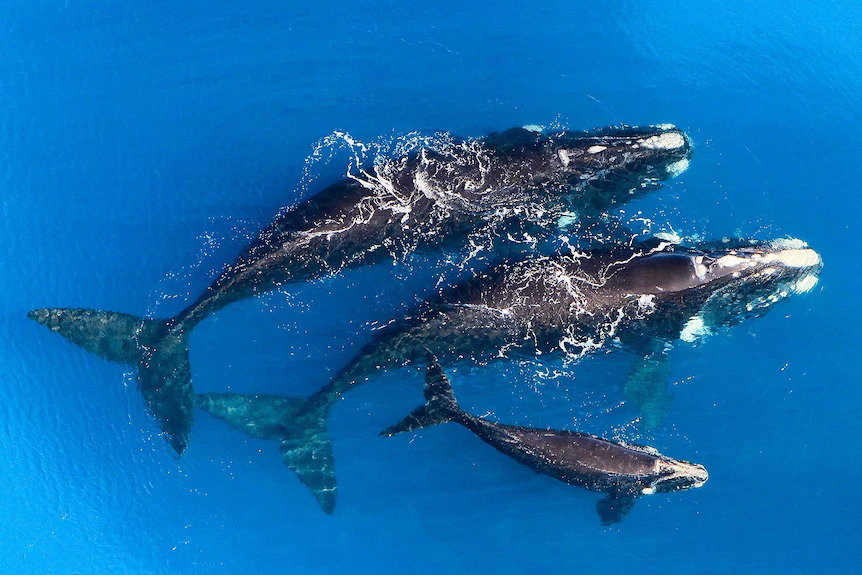
New research shows southern right whales in the Great Australia Bight might be using the shallow waters to whisper to their calves so that predators, like killer whales, can't hear them.
Acoustic crypsis, a way of adapting sound production behaviour akin to whispering, could be leading whales to choose certain breeding grounds to whisper to their calves.
The study by Syracuse University in New York looked at whale talk, comparing data from Brazil, South Africa and southern Australia to come to their theoretical findings.
Researcher Julia Zeh said the team studied how sound travelled in the habitat where southern right whales and calves spent a lot of their time.
"What we found is that they are potentially using these shallow waters, near shore habitats in part because that way they can't be heard by other animals outside those habitats," Ms Zeh said.
"They can make sounds and communicate with each other but their sounds won't travel far enough to be heard by anyone else."
She said the habitats were surprising for such large creatures.
"These mum-calf pairs spend time in these ridiculously shallow areas across the southern hemisphere," she said.
"We started out doing work in Brazil with these mum-calf pairs and they're found in waters that are just a few metres deep ,which is crazy considering that a whale is pretty wide on its own.
"They're in just a tiny bit of water and because of the ground there and the water, the sound waves will get absorbed very quickly."
Evasive action
Ms Zeh is one of three researchers who produced the paper, which was published in Royal Society Open Science.
Other work has been done on the whispering between mothers and calves but this research explored the benefits of shallow habitats.
"Some of the recent publications about these mum-calf pairs has shown that they do whisper and that they make some quieter calls to each other to communicate with each other," Ms Zeh said.
"So people started noticing they are doing these acoustically hiding things and then we found not only do they modify the sounds that they are producing, they may also be choosing locations to spend time in to hide as well."
Ms Zeh said while it was not known why the whales were hiding and whispering, there were theories.
"The primary predator of these large baleen whales, pretty much their only predator, is killer whales and especially for the vulnerable calves," Ms Zeh said.
''That's a risk, being herded by those whales but it may also be adult males of the same species. Read More...