What is Focus Breathing in a Camera Lens?
-
 Loading...
 - Nika Pavic
- 02 Jun 2022
- 297 Views
- 0 Like
- 0 Comment
Focus breathing is a term that is often used when discussing the features and specs of a camera lens. It is an issue that occurs across a wide range of lenses, and it is one that can negatively affect your photography and videography in certain situations. In this article, we will take a look at what focus breathing is, the situations it affects, and how you can avoid it.
What Focus Breathing Is
To begin with, what is focus breathing, anyway? Also known as “lens breathing,” it has to do with lenses and how they magnify images at different focusing distances.
Focus breathing refers to when a lens’s focal length changes subtly (or noticeably) as the focusing distance changes.
Both zoom and prime lenses exhibit this behavior to varying degrees. One way to see this for yourself is to frame a scene and then change your lens’s focus from minimum to infinity and pay close attention to the edges of the frame — you may notice that the shot seems to “zoom” ever-so-slightly in and out as the focal distance changes.
You can also take two photos keeping everything the same and just have the subject in focus at infinity in one case and at the minimum focusing distance (MFD) in the other. You will notice that there is a slight difference in the focal length (magnification) even though they were shot while keeping the focal length on the lens the same.
This is an exaggerated case of focus breathing since it increases as the distance between the two focused subjects (i.e. the focusing distance in the two photos) increases. Both the magnification and the angle of view change which gives us an apparent change in focal length.
A Visual Example of Focus Breathing
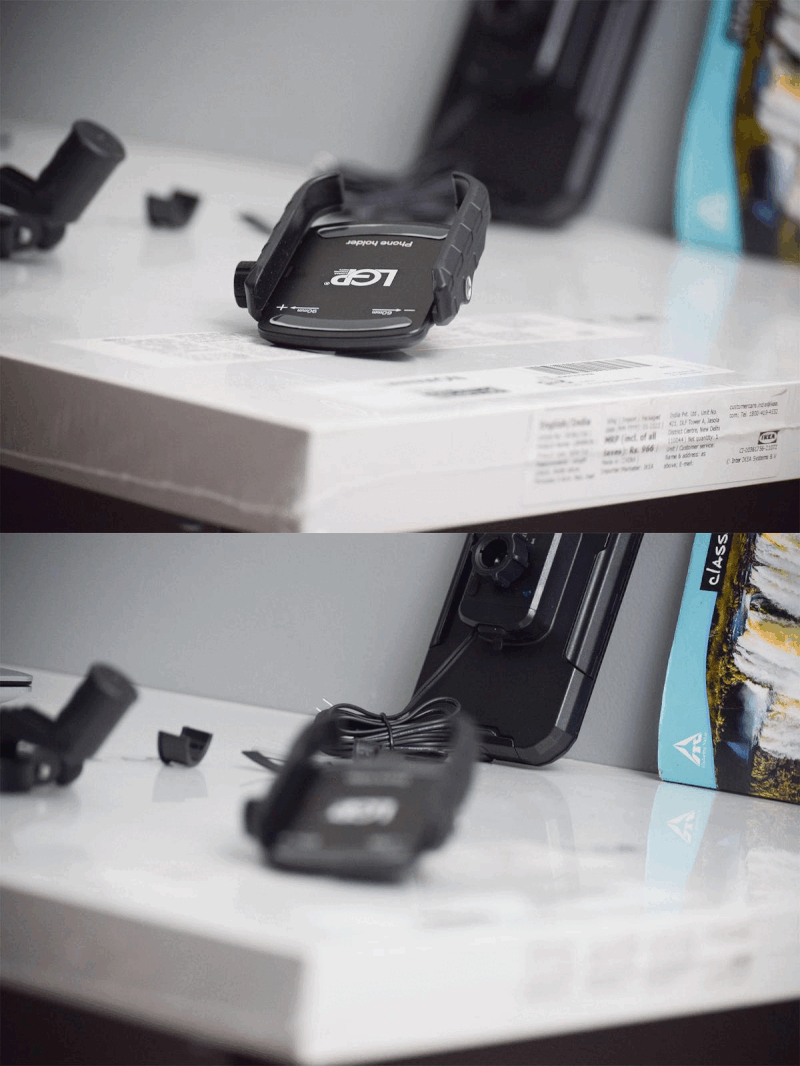
In the two example photos below, you can see that as the focus is changed from the mobile holder in the foreground to the mirror holder in the background, the second image seems to have been magnified and a little cropped in (they were not cropped in post-production).
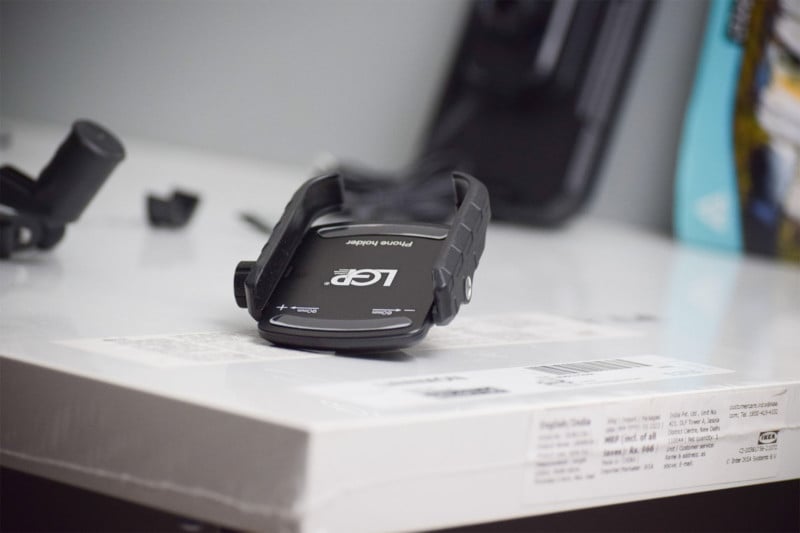
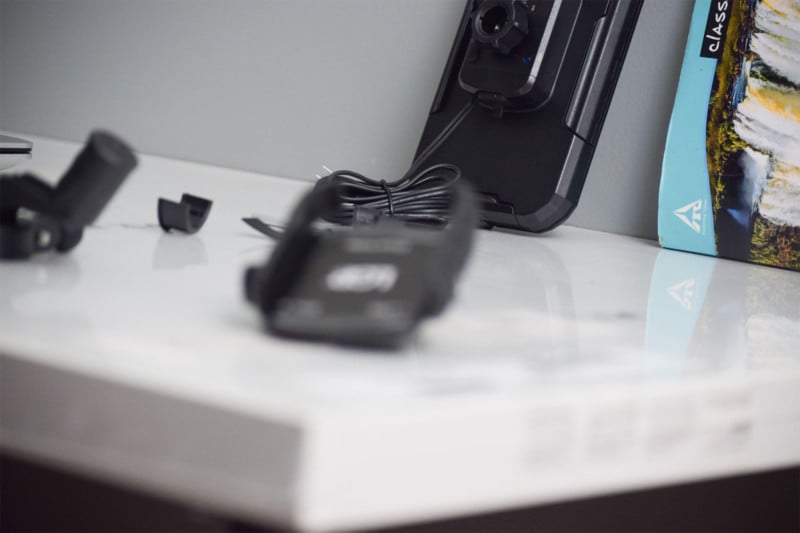
Without moving the camera or adjusting the focal length, the focus is adjusted to a further plane. Notice how the composition has slightly changed a the edges of the frame due to focus breathing.
Here is a GIF with the two photos alternating back and forth — notice how angle of view and magnification slightly change when only focus is adjusted:
Why Focus Breathing Occurs
Focus breathing occurs because most modern camera lenses typically use an internal focusing system. In these lenses, if we change the focus of the lens either manually or with autofocus, then the front of the lens element and the barrel of the lens do not move or rotate, which means only certain smaller lens elements inside the lens barrel need to move.
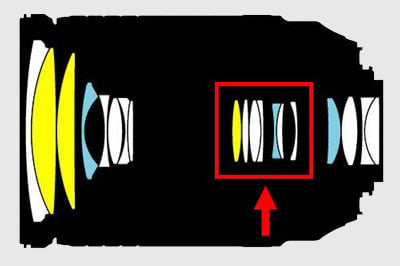
This type of internal focus system has a number of benefits, including portability (smaller and lighter designs), faster focusing (due to the smaller set of focus elements), compatibility with certain lens filters and lens hoods (due to front lens element not rotating during focusing), and a constant lens length (the front element does not extend during focusing, particularly helpful in macro photography).
The tradeoff, however, is focus breathing. Focusing on internal focus lenses causes the internal element to move independently of the other lens elements, causing a slight change in focal length.
There is a balance between how silent and optically perfect the lens is versus how much focus breathing it exhibits. This boils down to the design and construction of the lens and is also reflected in the price. Thus cinema lenses exhibit the least amount of focus breathing (or virtually none at all) but are priced much higher as compared to a photography lens designed primarily for still photos. Read More...