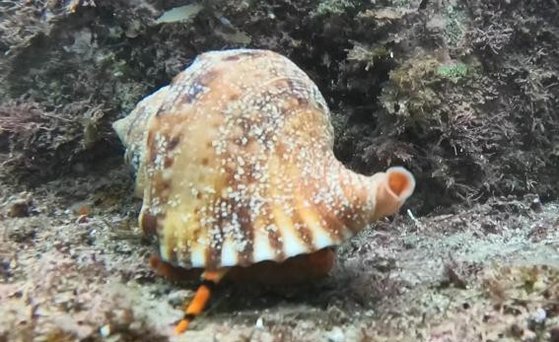
If you eat it, you will go to jail... A Class 1 endangered species resembling a conch

The Ministry of Environment and the Ministry of Oceans and Fisheries announced on the 21st that they will take strict measures in accordance with the law if they intentionally collect or distribute trumpets.
The Ministry of Environment and the Ministry of Oceans and Fisheries said on the same day that there was a case of collecting or distributing bugle conch by confusing it with other edible conch, such as conch.
The bugle conch has been designated as a nationally protected species as a first-class endangered wildlife and marine protected species.
Catching, collecting, damaging, or killing an endangered wildlife class 1 is punishable by imprisonment for not more than 5 years or a fine of not less than 5 million won and not more than 50 million won. If it is a habitual offender, imprisonment for not more than 7 years or a fine of not more than 70 million won is also imposed.
The penalty for capturing, collecting, or damaging marine protected creatures is 'up to three years in prison or a fine of up to 30 million won'. Transplanting, processing, distributing, or storing marine protected organisms without permission is punishable by imprisonment for not more than two years or a fine not exceeding 20 million won.
The trumpet conch can be used as a trumpet that makes a sound by making a hole in its shell, hence its name. In one area of ​​Jeju, it is said that a fisherman punched a hole in a bugle when gathering merchants at a port and blown it.
The trumpet conch is distributed in Korea, Japan, and the Philippines, and the adult gak height (shell height) and gak diameter (shell width) are 22 cm and 10 cm, respectively, making it the largest among conch inhabiting Korea. It is also known as the only natural enemy that eats starfish, the main culprit of sea desertification.
In Korea, it is mainly found in the sea near Jeju or offshore islands off the southern coast. It is mainly found at a depth of 10 to 20 m in the coast of Jeju, and is found at a depth of 30 to 50 m in the sea near the southern coast of the island. Recently, it was also found in Taean, Chungcheongnam-do and Pohang, Gyeongbuk. Read More…