Why Jupiter lacks ring system like Saturn
-
 Loading...
 - Vicente Montoya
- 26 Jul 2022
- 95 Views
- 0 Like
- 0 Comment
Jupiter should have more impressive, larger rings than Saturn since it is larger. However, according to a recent study from UC Riverside, Jupiter's enormous moons block this vision from illuminating the night sky.
The findings of the research were published in the journal 'Planetary Science'.
"It's long bothered me why Jupiter doesn't have even more amazing rings that would put Saturn's to shame," said UCR astrophysicist Stephen Kane, who led the research.
"If Jupiter did have them, they'd appear even brighter to us, because the planet is so much closer than Saturn." Kane also had questions about whether Jupiter once had fantastic rings and lost them. It is possible for ring structures to be temporary.
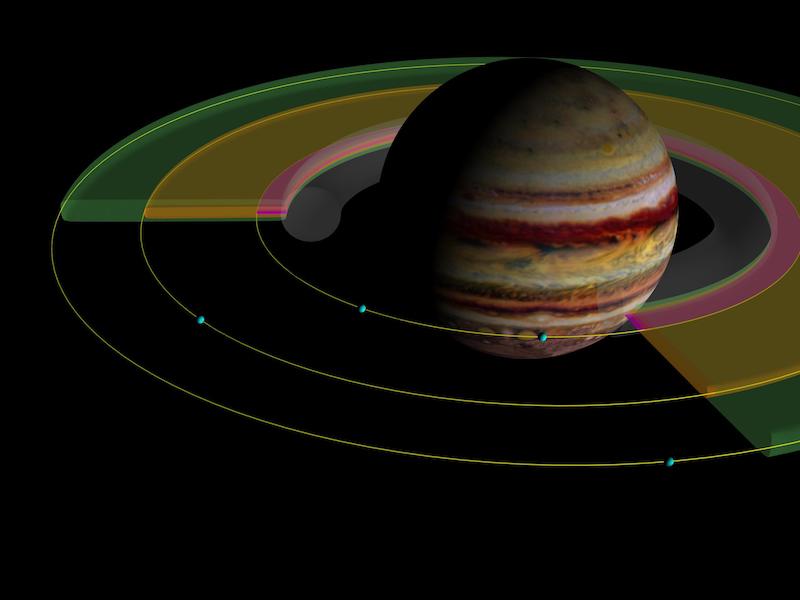
To understand the reason Jupiter currently looks the way it does, Kane and his graduate student Zhexing Li ran a dynamic computer simulation accounting for the orbits of Jupiter's four main moons, as well as the orbit of the planet itself, and information about the time it takes for rings to form. Their results are now online, soon to be published in the Planetary Science journal.
Saturn's rings are largely made of ice, some of which may have come from comets, which are also largely made of ice. If moons are massive enough, their gravity can toss the ice out of a planet's orbit, or change the orbit of the ice enough so that it collides with the moons.
"We found that the Galilean moons of Jupiter, one of which is the largest moon in our solar system, would very quickly destroy any large rings that might form," Kane said. As a result, it is unlikely that Jupiter had large rings at any point in its past.
"Massive planets form massive moons, which prevents them from having substantial rings," Kane said.
All four giant planets in our solar system -- Saturn, Neptune, Uranus and also Jupiter -- do in fact have rings. However, both Neptune and Jupiter's rings are so flimsy they're difficult to view with traditional stargazing instruments.
Coincidentally, some of the recent images from the newly commissioned James Webb Space Telescope included pictures of Jupiter, in which the faint rings are visible. Read More...